
How to check an offshore casino licence yourself, step by step
Find the licence claim in the site’s footer or terms, then look up the company name and licence number on the regulator’s own website, never through the seal or link the casino gives you. The claim holds only if the regulator lists the same company, an active status and, where the register shows domains, the domain you are on[1][2]. Even a valid offshore licence gives no permission under Malaysian law.
Why this check matters more for Malaysian readers
No online casino is licensed in Malaysia, so every site that accepts ringgit is regulated, if at all, somewhere else. The foreign licence is the only thing standing between you and an operator answerable to nobody. It is also the single claim that Malaysia-facing sites most often get wrong, overstate or invent. Our plain-English guide to Malaysian online gambling law explains why the licence never makes play lawful here. This page deals with the narrower question: is the licence real?
The check takes about ten minutes. You do not need an account at the casino, and you should not create one in order to do it.
Step 1: find the exact claim
Scroll to the footer of the site and open its terms and conditions. A real licence claim names four things:
- the regulator;
- a licence number;
- the legal name of the licensed company;
- the company’s registration number and address.
Copy those four details exactly. A footer that says only “licensed and regulated” or shows a logo with no number is not a licence claim. It is decoration.
Write down the domain you are on as well. Many brands that market to Malaysians operate several domains, and the licence, if there is one, may cover some of them and not others.
Step 2: go to the regulator yourself
Do not click the licence seal on the casino’s page. A seal is an image and a link that the casino controls. It can point to a convincing copy of a validator page. Type the regulator’s address yourself, or use the addresses below, which we read on 28 October 2026:
- Curaçao Gaming Authority: its licence register page publishes downloadable lists of online gaming licences, certificate holders and an enforcement register[1]. The authority itself warns that these overviews “do not guarantee the current validity of the licenses” and that “no rights can be derived” from them, so treat a match as a starting point[1]. Since 7 October 2026 its seal checker has also been affected by the shutdown of its licensing portal after a data breach, so the register is the more dependable check for now[3]. Claims to operate under an old “/JAZ” master licence no longer count: our guide to Curaçao master licences explains why.
- Anjouan Gaming Authority: its public licence register lists, for each holder, the company, status, licence number, licence type, issue date, expiry date and domains[2]. Our guide to Anjouan licences covers what one does and does not give players.
- PAGCOR (Philippines): its electronic gaming page publishes lists of accredited operators and their registered brands and domain names[4]. Read step 4 before you take any Philippine licence at face value, and our guide to PAGCOR claims after the offshore gaming ban.

Step 3: match every detail, not just the name
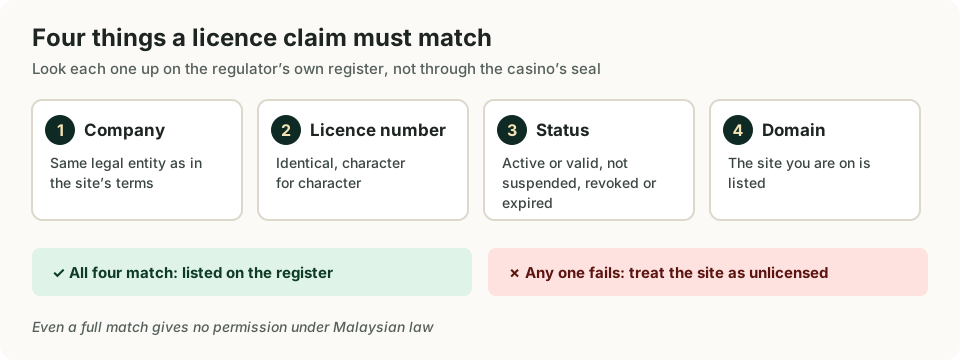
A match needs all of the following to line up:
- Company. The licensee name on the register is the same legal entity named in the casino’s terms. A similar name is not a match.
- Number. The licence number is identical, character for character. A number that is close but not the same is a different licence, or no licence at all.
- Status. The status reads active or valid, not suspended, revoked, surrendered or expired. Anjouan publishes expiry dates, so check that the date has not passed[2].
- Domain. Where the register lists domains, the domain you are on appears there. If it does not, the licence may be real while the site in front of you is not covered by it.
If the register shows nothing for the company or number, the claim is unverified. It may be out of date, it may cover a different brand, or it may be false. You cannot tell which from the outside, and it is not your job to give the operator the benefit of the doubt.
Step 4: know which claims are weak even when they are real
The regulator matters as much as the match. The Philippines ordered offshore gaming operators and internet gaming licensees to cease all operations by 31 December 2024, and stated that their licences would not be renewed or extended[5]. A site that serves Malaysia while displaying a Philippine offshore licence is relying on something that no longer authorises that business.
Other regulators differ widely in what they publish and what they do with complaints. A regulator that publishes an enforcement register, as Curaçao does, at least gives you a record to search[1]. Search that record for the company name as well as the brand.

Step 5: check the record around the licence
A valid licence tells you who regulates the operator. It does not tell you how the operator behaves. Before forming a view, search for:
- the company name together with the words complaint, withdrawal and fine;
- the brand together with “fake” or “clone”, to find warnings about copies of the site;
- Malaysian news coverage, to see whether the brand features in enforcement reporting.
Our licence checks of eight brands Malaysians search for show this method applied in full, with every source dated. They also show how often the answer is “we could not confirm it”.
What each result means
- Verified: the register shows the same company and number with an active status. This is the best result an offshore site can get. It still does not make play lawful in Malaysia.
- Claimed but not found: the site names a licence, but the register does not show it, or shows a different company, an inactive status or other domains. Treat the site as unlicensed.
- No claim: the site names no regulator and no number. There is nobody to complain to and nothing to check.
If you are checking a licence because you are already worried about money you have deposited, or about how much you are playing, the licence is the smaller problem. Our guide to free gambling help in Malaysia lists services that will talk to you today.
Questions readers ask
How do I know if an online casino licence is real?
Look up the company name and licence number on the regulator’s own website, typed in yourself rather than reached through the casino’s seal. The claim holds only if the register shows the same company, the same number, an active status and, where domains are listed, the domain you are on.
Can I trust the licence seal on a casino website?
Not on its own. The seal is an image and a link controlled by the casino, and it can lead to a copy of a validator page. Use it only to find the licence number, then check that number on the regulator’s site directly.
Is a PAGCOR licence still valid for sites serving Malaysia?
Not for offshore play. The Philippines ordered offshore gaming and internet gaming licensees to stop operating by 31 December 2024, and said those licences would not be renewed or extended.
What does it mean if the licence is not on the register?
The claim is unverified. It may be outdated, it may belong to another brand, or it may be false. Without a register entry there is no regulator you can show to be responsible for the site, so treat it as unlicensed.
Does a valid licence make it legal to play from Malaysia?
No. Malaysia does not license online casinos, and a foreign licence gives no permission under Malaysian law. It only tells you which foreign regulator, if any, oversees the operator.
Sources
Every source below was read on the date shown. Operator pages are named but not linked: this site does not link to gambling operators.
- License register (online gaming licences, certificates, enforcement register). Curaçao Gaming Authority. Read on 28 Oct 2026.
- License Register. Anjouan Gaming Authority. Read on 28 Oct 2026.
- Announcement: transition to a new platform (7 October 2026), PDF. Curaçao Gaming Authority. Read on 29 Oct 2026.
- Electronic Gaming: lists of licensees, registered brands and domain names. Philippine Amusement and Gaming Corporation (PAGCOR). Read on 28 Oct 2026.
- Executive Order No. 74, s. 2024: immediate ban of Philippine offshore gaming, internet gaming and other offshore gaming operations. Supreme Court of the Philippines E-Library. Read on 28 Oct 2026.
- Online Gaming License Registry (last updated 20 October 2026), PDF. Curaçao Gaming Authority. Read on 28 Oct 2026.